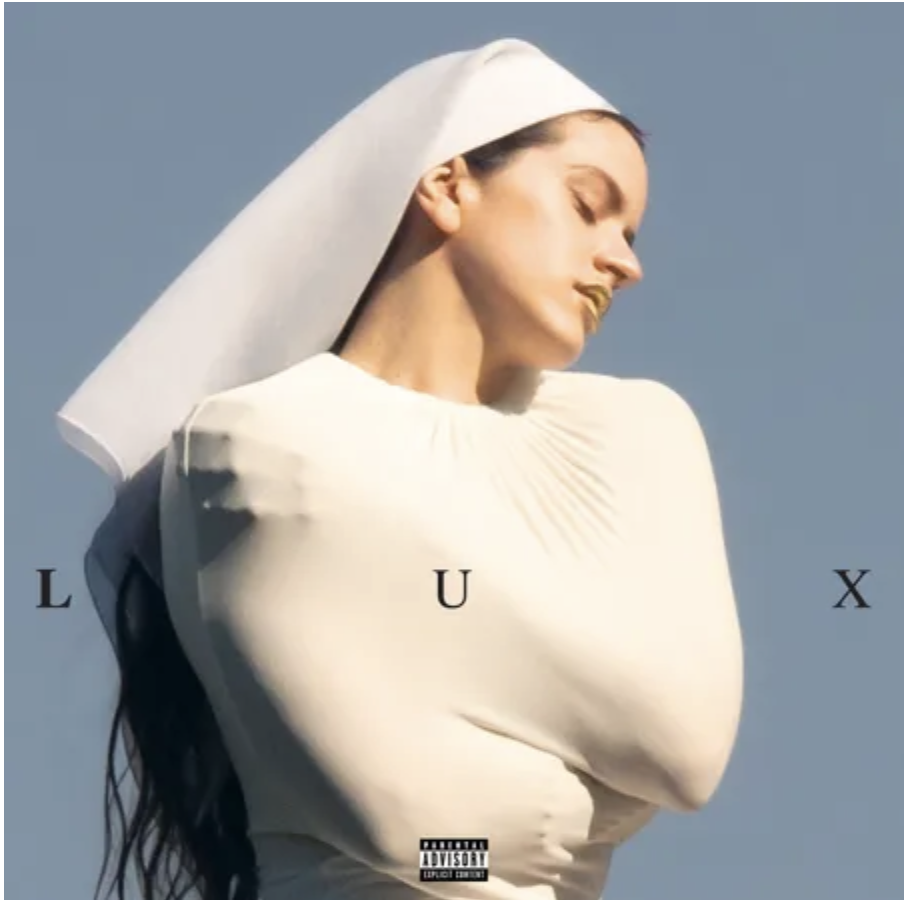
The 4-time Grammy-winning artist, Rosalia, is famous for her creative mixture of different genres, sounds, and even languages. The singer is most known for her flamenco roots from her home country of Spain; however, her work has increasingly become more unique as she has embraced her Latin style while simultaneously creating fusions with other types of music. Despite her impressive work in previous albums, her newest discography, “Lux”, might be her most ambitious yet, combining classical music, pop, and even opera, all sung in 13 languages.
Rosalía first announced that she was releasing a single named after the famous techno club in Berlin, “Berghain”. As the music industry is fresh off a summer filled with club hits from Charli XCX’s “Brat”, many were expecting dance music; however, the song was a complete surprise that consisted of music straight from an orchestra. The song is mesmerizing as Rosalía sings completely in German. She doesn’t stop there, as the album also includes songs with lyrics in Ukrainian, Italian, English, Catalan, Latin, Arabic, and much more. The musician told the New York Times: “It’s a lot of trying to understand how other languages work…it’s a lot of intuition and trying to be like, ‘I’m going to just write and let’s see how these will sound in another language.’” The artist continued to explain how her love for traveling inspired her to challenge herself linguistically, stating that it helped expand her way of thinking as a singer, a musician and an artist.
Rosalía also attributed her eagerness to incorporate these languages to her love of the process of learning something new, comparing how she first learned flamenco and the steps that were taken to ensure her pronunciation and understanding of her lyrics were perfect. “Through understanding the other better, maybe you can understand yourself better, and you can learn how to love better.” For Rosalía, her music isn’t just what is most popular or what the masses would enjoy the most; she uses her music and the artistic process to simply become a better and more emotionally intelligent human being.
On a personal level, this is something that I greatly admire. Many Latin artists have shifted their music to be more Americanized; indie artists have changed their sounds and lyrics to fit into the pop music that is most popular today, music that will become the newest sound bite on TikTok or Instagram. Rosalía is a real example that in order to create real art that impacts the creator and the audience simultaneously, one must challenge oneself and take risks.
The thoughts on Rosalía throughout her career have been varied. Many have waited for her to make the “eventual” crossover into complete English-language music, while others have criticized her for “cultural appropriation” or capitalizing off of cultures that don’t belong to her. Lux is Rosalia’s way of showing that she can blend cultures and take inspiration in order to become a better artist. In the same New York Times interview, Rosalía makes a statement that encompasses her thought process when creating music: “I belong to the world.” She does not intend to make these languages, cultures, or music genres “hers”, but instead become a product of the world and what she’s learned from it.
Sources:
“Rosalía’s Thrilling Pop Evolution on ‘Lux’: Singing in 13 Languages – The New York Times.” NY Times, www.nytimes.com/2025/10/30/arts/music/rosalia-lux-interview.html. Accessed 8 Nov. 2025.
Savage, Mark. “Radical and Riveting: Is Rosalía’s Lux the Year’s Best Album?” BBC News, BBC, 7 Nov. 2025, www.bbc.com/news/articles/cd9kgy853zvo.