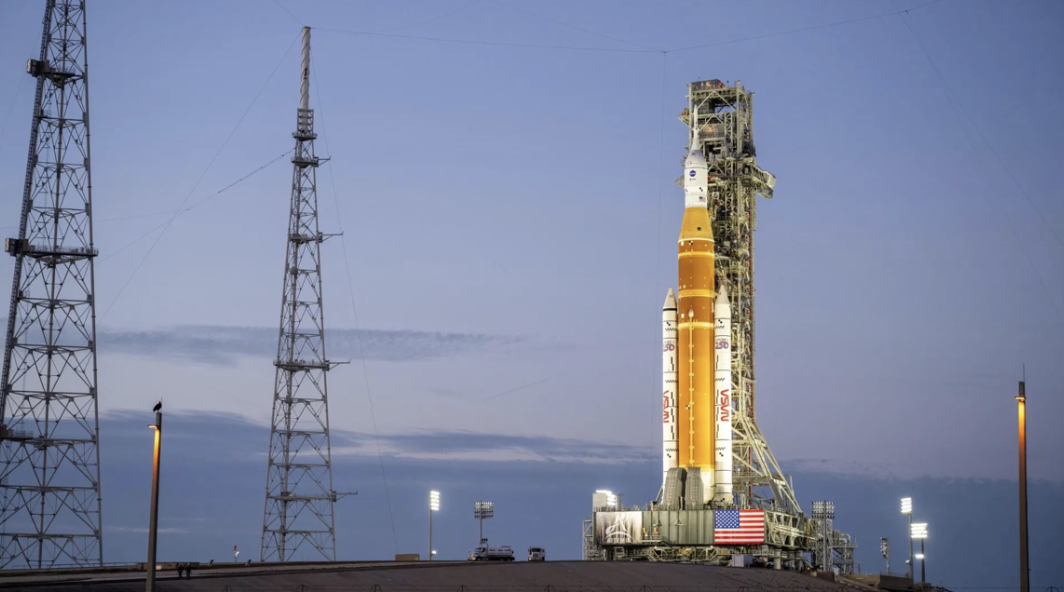
On April 1, 2026, a rocket lifted off from Kennedy Space Center carrying four astronauts headed for the Moon, a destination that has not been reached by humanity since 1972. The Artemis II mission lasted under 7 days and concluded with a splashdown in the Pacific Ocean just off the coast of San Diego, California. Contrary to what has been implied by the notion that humanity is returning to the moon, the Artemis II crew did not land on the Moon itself; however, its impactful journey may be one of the most important space missions in decades.
Artemis II took NASA astronauts Reid Wiseman (commander), Victor Glover (pilot), and Christina Koch (mission specialist), along with CSA astronaut Jeremy Hansen, on a nearly 10 day journey around the Moon and back to Earth. The crew named their Orion capsule Integrity. They flew 694,481 miles in total and their lunar flyby took them farther than any humans have ever traveled, surpassing the previous distance record set by Apollo 13 astronauts in 1970 (NASA 2026). During their April 6 lunar flyby, the astronauts captured more than 7,000 images of the lunar surface and a solar eclipse. The imagery includes views of earthset and earthrise (from the Moon’s perspective), impact craters, ancient lava flows, the Milky Way galaxy, and surface fractures and color variations across the lunar terrain (CNN 2026).
Artemis II was a crewed flyby of the Moon, the first crewed flight beyond low Earth orbit since Apollo 17 in 1972. The mission’s primary goal was to validate the Orion spacecraft’s systems, crew operations, and mission procedures ahead of further lunar exploration in future Artemis missions. Future missions, such as Artemis IV and beyond, are planned to land at the Moon’s south pole, and that is where the most significant science lies (NASA 2025).The crew documented the topography along the terminator (the boundary between lunar day and night), where low angled sunlight casts long shadows across the surface, creating illumination conditions similar to those in the South Pole region where astronauts are scheduled to land in 2028, meaning every image captured was both a scientific observation and operational data for future missions (NASA 2026).
The focus on the lunar south pole is driven primarily by the discovery of water ice. For most of the space age, the Moon was considered geologically dry as Apollo rock samples showed no signs of hydration, and the prevailing assumption was that extreme daytime temperatures above 120°C would evaporate any water over time. However, as a result of the Moon’s spin axis being nearly vertical at 1.5°, the Sun remains near the horizon at the poles, causing the floors of certain polar craters to remain in permanent shadow, forming cold traps where water ice may be preserved. This caused the subsequent discovery of NASA’s Moon Mineralogy Mapper, aboard India’s Chandrayaan-1, confirmed the presence of water ice at the lunar poles (Carrol 2026).
Water provides radiation shielding, causing it to be highly effective at absorbing and scattering the high-energy protons and neutrons of galactic cosmic radiation and solar particle events, which makes water the single most strategically important resource on the Moon in order to preserve life and establish a human base (NASA 2026). It can be electrolyzed into hydrogen and oxygen for rocket propellant, used for life support, and deployed as shielding. This indicates that if the Moon’s south pole contains accessible water ice in sufficient quantities, the Moon stops being merely a destination and has the potential to become a permanent station for humanity, enabling further explorations to Mars and beyond (Scientific American 2024).
NASA continues to target early 2028 for the first Artemis lunar landing, where the crew will transfer from Orion to a commercial lunar lander for their descent to the Moon’s surface. Artemis IV will be the first crewed Moon landing mission since Apollo 17 in 1972, with astronauts conducting scientific studies before returning to Earth. Artemis V will land another crew and begin building a Moon base, with subsequent missions planned roughly once per year (NASA 2025). Although this timeline is unreliable as Artemis II itself suffered years of delays, the mission that completed on April 10, 2026 demonstrated something important beyond its engineering objectives: that humans can still go to the Moon, that the systems to do so reliably exist, and that the scientific justification is stronger than it has ever been. Artemis II did not land on the Moon, but it shows that humanity is still able to do so, and building the foundation for what comes when we do, may be the most important step humanity has taken in space exploration since the Apollo missions in the 1970’s.
References
Carroll, M. (2026, January 29). Why NASA is targeting the Moon’s south pole for Artemis. Astronomy.https://www.astronomy.com/science/why-nasa-is-targeting-the-moons-south-pole-for-artemis/
CNN. (2026, April 6). Artemis II takes in unprecedented views in historic moon flyby: Highlights CNN.https://www.cnn.com/2026/04/06/science/live-news/nasa-artemis-2-flyby-moon-mission
NASA. (2025, March 25). Artemis science. National Aeronautics and Space Administration.https://www.nasa.gov/humans-in-space/artemis-science/
NASA. (2026). Artemis II: NASA’s first crewed lunar flyby in 50 years. National Aeronautics and Space Administration.https://www.nasa.gov/mission/artemis-ii/
NASA. (2026). Moon to Mars: NASA’s Artemis program. National Aeronautics and Space Administration.https://www.nasa.gov/humans-in-space/artemis/
Scientific American. (2024, February 20). Can NASA’s Artemis Moon missions count on using lunar water ice? https://www.scientificamerican.com/article/can-nasas-artemis-moon-missions-count-on-using-lunar-water-ice/